
Submit Your Research
Get published in WJMBS — Peer-reviewed, Open Access journal with rapid publication
FOREWORD
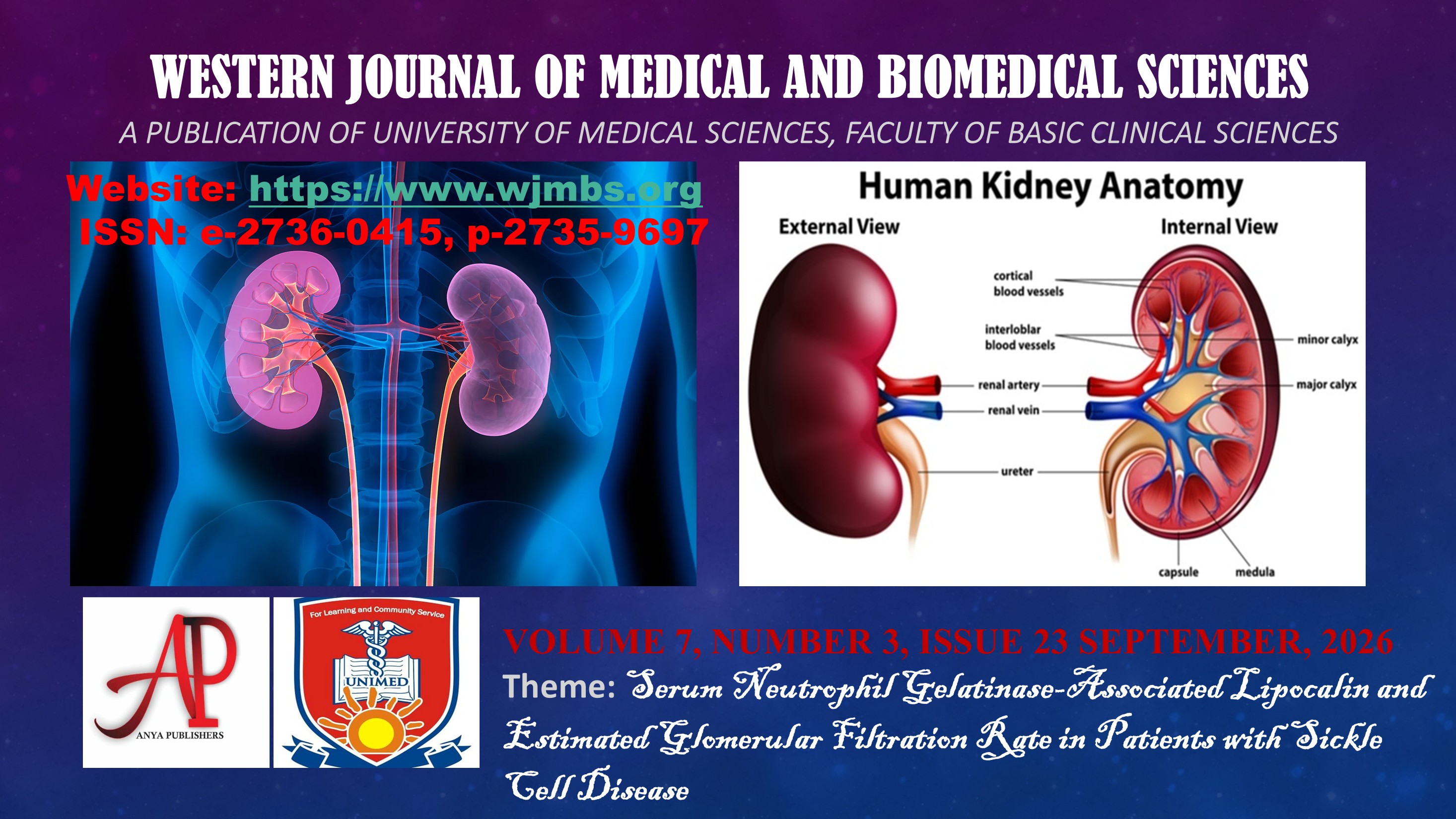
Volume 7 Number 3 Issue 23 comes with the theme: “Serum Neutrophil Gelatinase-Associated Lipocalin and Estimated Glomerular Filtration Rate in Patients with Sickle Cell Disease” where a team of researchers set out to determine the relationship between serum NGAL and eGFR in patients with SCD in a cross-sectional study among 245 adults with homozygous SCD (HbSS) attending the sickle cell clinic of Aminu Kano Teaching Hospital, Nigeria. This was against the backdrop of exploring the possibility of using Serum Neutrophil Gelatinase-Associated Lipocalin in assessment of renal injury in SCD patients. They found a strong statistically significant inverse correlation between serum nGAL and eGFR (Spearman's ρ = −0.750, p < 0.001), indicating that increasing serum nGAL concentrations were associated with declining renal function. They then concluded that nGAL may serve as a complementary marker to eGFR for early detection of sickle cell nephropathy.
Gastric cancer, though a major public health disease is often underestimated in Subsaharan Africa. In this study a team of researchers in a study evaluated the clinico-pathological profile, surgical outcomes, and psycho-behavioural responses of patients with gastric cancer managed at the Alex Ekwueme Federal University Teaching Hospital, Abakaliki, in South-East Nigeria. The following were their key findings: Regular consumption of traditionally smoked fish was reported by 91.9% (n = 79) of patients. At presentation, 88.4% (n = 76) had unexplained weight loss and 73.3% (n = 63) had a palpable abdominal mass. Intraoperative assessment showed locally advanced disease in 61.6% (n = 53) and macroscopic distant metastasis was found in in 40.7% (n = 35). Curative-intent resection was performed in 50.0% (n = 43) of cases, while the remainder underwent palliative gastrojejunostomy bypass (31.4%, n = 27) or exploratory laparotomy with biopsy (18.6%, n = 16). Clinical depression was documented in 40.7% (n = 35) of patients, and 9.3% (n= 8) absconded from care before definitive treatment. Most of the patients presented in advanced stage making treatment difficult, and hence advised on improved health awareness and screening facilities.
In another study, researchers evaluated haemostatic biomarker abnormalities among serologically cleared voluntary blood donors at a Nigerian tertiary referral centre. This is aginst the backdrop of the present practice in both secondary and tertiary health centres where blood for donation is screened for a limited number of infections and also tested for a limited number of clotting abnormalities and then declared safe for transfusion. In this study the researchers measured six biomarkers: platelet count (Sysmex XN-1000), fibrinogen (ELISA), prothrombin time (PT), international normalised ratio (INR), activated partial thromboplastin time (aPTT), and D-dimer (ELISA). They found that: Most donors (83.3% male; 26–35 years predominant) had normal biomarker profiles; however, shortened PT indicating a hypercoagulable phenotype was detected in 35.0% (n = 63), prolonged aPTT in 11.7% (n = 21), platelet count abnormalities in 20.6% (thrombocytopenia 10.1%; thrombocytosis 10.5%), elevated fibrinogen in 4.4%, and elevated D-dimer in 2.8%, with all participants having cleared standard infectious disease screening. Overall, a substantial proportion of serologically cleared donors harboured haemostatic abnormalities, most notably a hypercoagulable phenotype in more than one in three donors, providing an evidence-based argument for incorporating haemostatic profiling into pre-donation assessment frameworks in resource-limited settings.
Professor Michael Simidele Odimayo
Editor-In-Chief
30th September, 2026
Get published in WJMBS — Peer-reviewed, Open Access journal with rapid publication